|
|
|
|
Home >European
Touring > Europe 2006 > Slovenia
2006 Part 4 |
|
|
Slovenia 2006 Part 4
Final days visiting gorges, lakes and mountains
|
Part 1
Part 2
Part 3
|
Day 11 - A hidden gorge, a hidden museum (and a hidden supermarket)
Needing a provisions top up we drove back through Bled to Lesce where
there were flags on the lampposts advertising a Hofer (Aldi) store 1.4km
away but we never found it and eventually spotted a brand new Spar next to the
bypass road. After a cool shop we emerged to scorching midday sun so headed back
to Bled and followed intermittent signs to the Vintgar gorge 4km to the
north, near the village of Podhom. After lunch in the free car park we paid our
700SIT entrance fee and set off along the path and wooden walkways cut into the
cliffs through this impressive and peaceful, once the parties of schoolchildren
had been passed, 1600 metres long river gorge. At the end behind a cafe and toll booth
there was a path down steps to the bottom of a high waterfall. The gorge was
only discovered in 1891 and within two years the walkway was built and it became an
immediate tourist attraction.
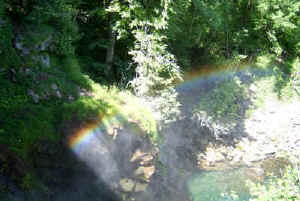
Vintgar Gorge
Returning to Lake Bled we drove on to Radovljica to visit the Museum of
Beekeeping, not signposted from the main road, so we parked and walked a couple of hundred metres
to the pedestrianised centre of the town with many old buildings and murals. The
museum is in an old baroque manor house with a magnificent but well worn hall and
staircase.
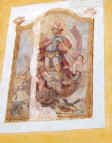
Radovljica
mural
Beekeeping was (and still is) a major activity in Slovenia. Many old and
strange beehives were on show including a glass fronted one with working bees and a
fascinating display of decorated beehive panels with paintings of many religious and less
reverent subjects dating back centuries. Admission was 500SIT each and it made
an interesting diversion for a couple of hours. Unfortunately photography wasn't
allowed inside the museum but they have a website www.muzeji-radovljica.si
On the main shopping street in
the town was another more modern beehive mosaic on a former bank building.
We stopped for tea by the southwest shore of Lake Bled next to the Rowing club
and playpark. There were pleasant lakeside walks from here and gondola trips to
the island. Apart from a few large and luxurious hotels and restaurants at the
north-east edge of the lake we found this area to be pleasantly
underdeveloped.
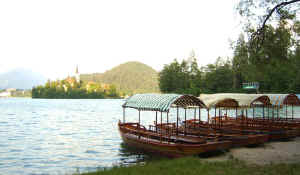
Gondolas on
Lake Bled
We returned to the campsite mid-evening to find a Dutch caravan had pitched less
than 2 metres away from our tent (why when the site was less than half
full?)
|
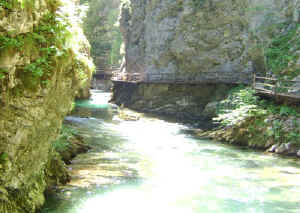
Vintgar Gorge walkway
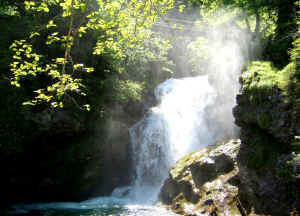
Waterfall at Vintgar Gorge
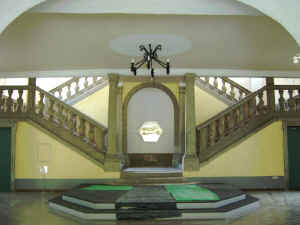
Radovljica staircase
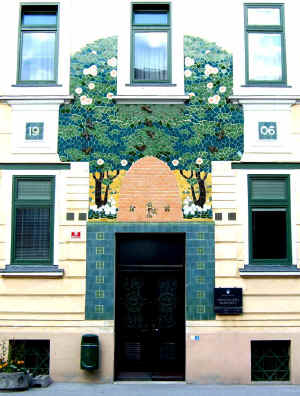
Beehive mosaic Radovljica
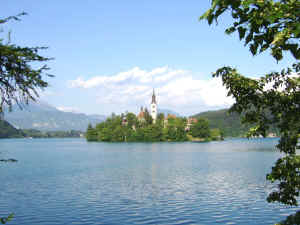
Lake Bled island
|
Day 12 - to the mountains and Lake Bohinj
To the west of the campsite the road continues to the small town of
Ribcev Laz and Lake Bohinj (Bohinjsko Jezero) a large dark lake with woods
and steep mountains to the north and south. We parked at the cable car
station and took the new cable car up to the Vogel ski station on a plateau
1535 metres altitude. The trip up in the cable car (expensive at 4800SIT, €20 return) was
accompanied by piped musak of 1950's English pop tunes! Once at the top ski
station the lake below is not visible but there are fantastic panoramic
views, if you ignore
the usual mess of ski lifts, fencing and signs blotting the landscape, of the Julian Alps with the prominent Triglav mountain, the three peaks being
Slovenia's national symbol - even incorporated into the national flag, to the north.
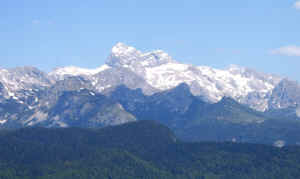
Triglav from Vogel
There were also the last remnants of snow (in mid June) but a
few wild flowers were struggling to grow including vivid blue gentian. There are
waymarked walks to the mountain peaks from here and a long walk down to the
lake. After returning to the base
station (by cable car) we found a pleasant lakeside layby in the woods for lunch. Back at
Ribcev Laz there is a tourist bureau mostly for accommodation booking and
gifts, and more lakeside walks. The church here has many frescoes dating
from the 15th century but was closed for restoration. There are two famous
statues here, one of Zlatarog the legendary chamois with golden horns (and the
major Slovenian beer brand), the other commemorating the first climbers of Triglav. For the
return journey to Bohinjska Bistrica we drove along a narrow minor road
through the villages of Stara Fuzina and Studor where there many traditional
double and single hayracks still in use.
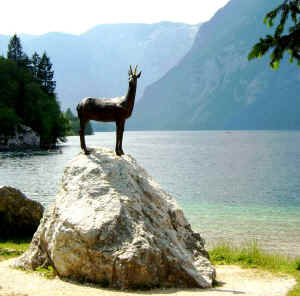
Zlatarog statue
|
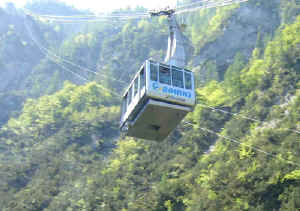
Vogel cable car
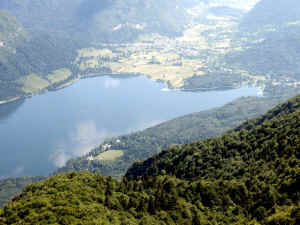
Lake Bohinj from Vogel cable car
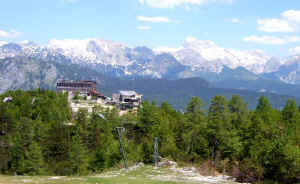
Vogel hotel and ski station
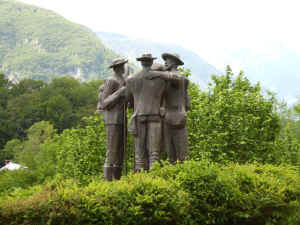
Triglav climbers statue
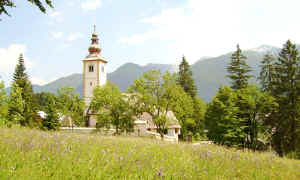
Ribcev Laz church
|
|
Day 13 Farewell
to Slovenia
We awoke to sounds of school
children to find there was a cycling proficiency lesson taking place on the
campsite roads at 8am - and why not - with hopefully slow traffic, plenty of
road junctions and pedestrian campers on their way to the toilet block to
negotiate around? (probably not a sight you'd see at a caravan site in the
UK!). Another amazing sight on the campsite was the humourous mural on the
wall of the amenities block. After settling our 3 nights' bill at the office we headed again back
to Bled (there are no roads west over the mountains from the Bohinj Valley)
and on to the busy main road to Jezenice, a large industrial town, and
avoiding the motorway signs to Austria took the road to Kranjska Gora, an
alpine sports resort with much building work going on, and after a final
fill up with cheap diesel we crossed the border to Italy on the road to
Tarvisio.
|
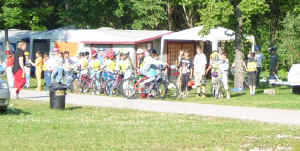
Cycling Proficiency lesson
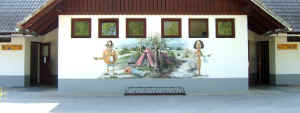
Camping Danica mural
|
Postscript
We found Slovenia to be an interesting country to visit with friendly
people, mainly good roads and modern facilities. As for living costs food
and diesel were a bit cheaper than in Austria and campsite fees varied from
10€ to 24€ a night. A few Slovenes we spoke to felt that living costs
had risen a lot since joining the EU and they expected more price rises when
they changed over to the EURO in 2007.
Slovenia's historical influence has been Austria, Hungary and Italy so
it doesn't have the Mediterranean feel of more southerly European
countries. The capital Ljubljana with a population of about 300,000 is
compact having a mixture of old and modern and elsewhere there a few
signs of former times. There were many places we missed in the two
weeks we spent there (we would have stayed longer if the weather had
been sunnier). For instance we didn't visit any show caves such as
those at Postojna, other tourist attractions such as Predjama Castle
and the coastal resorts of Piran and Koper. There are many other sights
worth visiting such as mining museums, many health spas and vineyards
as well as the Lipica stud farm to see the Lipizzaner horses, and we
felt that away from Ljubljana and Bled the trappings of tourism were
understated. Many historical sites remain from the various wars fought
over the centuries and there is a vast range of attractive scenery, but
often some homework and studying of the guidebooks is needed to find
some of the attractions. We hope we have presented a favourable taste
of Slovenia.
|
<< Part 3
|
into
the Italian Dolomites >>
|
| top | Home
| Europe 2006 | Campsites 2006
| European Touring |
|